
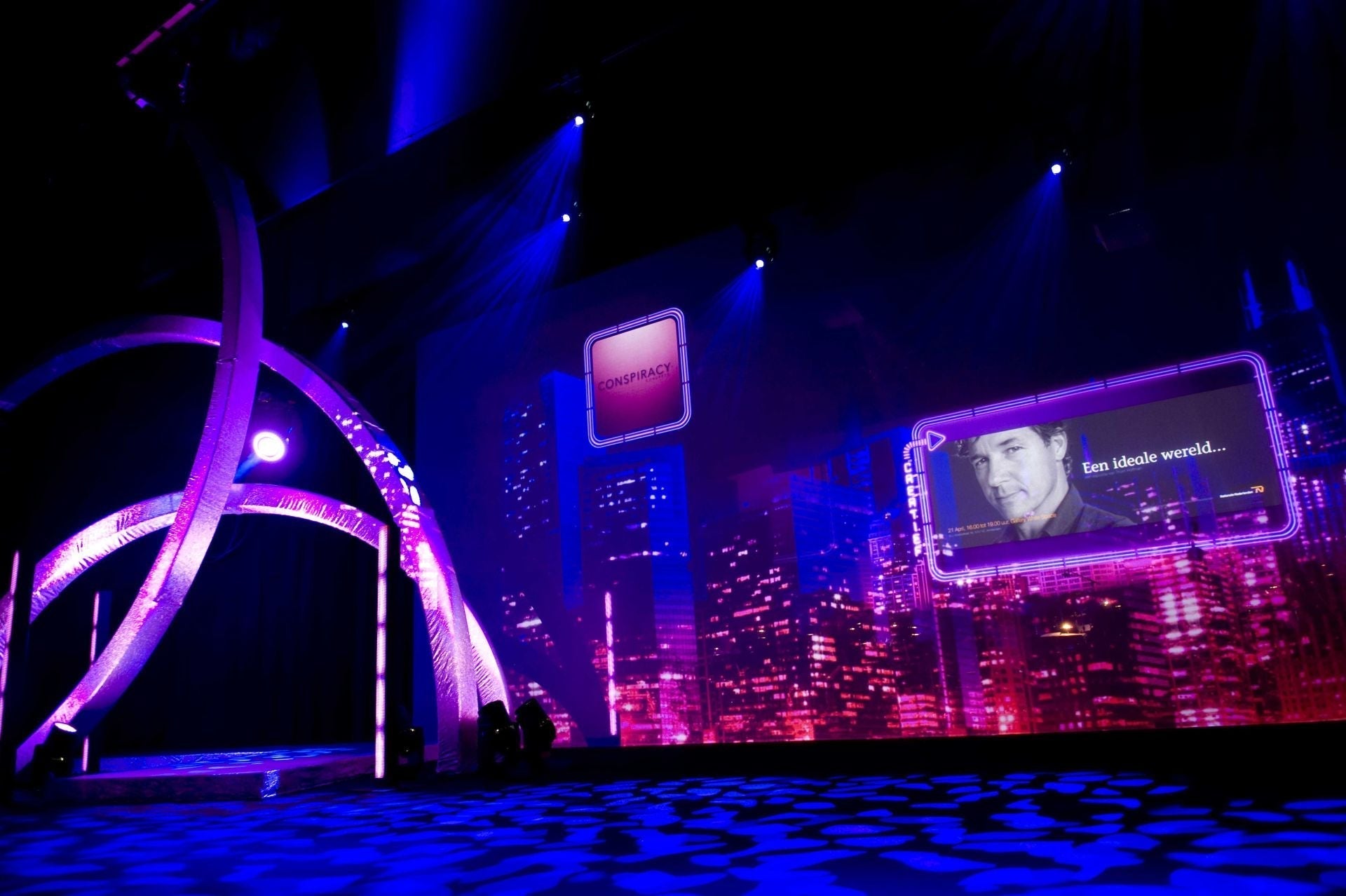
Gobelin Tule.
The fabric that makes objects appear and disappear
At first glance, Gobelin Tule looks like a simple, open-weave fabric. Yet it is one of the most remarkable fabrics in the theatre world. With the right lighting, a Gobelin can become virtually invisible, whilst the same fabric may appear completely opaque just a few seconds later.
That is precisely why Gobelin has been used for decades in theatre shows, product launches, museums, trade fairs and television productions.
In this blog, we explain how Gobelin works, why light is more important than the fabric itself, and how to achieve the maximum effect.
What is Gobelin Tulle?
Gobelin Tulle, better known internationally as Sharktooth Scrim, is an open-weave mesh fabric.
Thanks to its open structure, it allows plenty of light through, whilst – depending on the lighting – it can actually appear solid.
That may sound contradictory, but that is precisely where the magic lies.
Gobelin is made from a finely woven network of threads.
This creates a fabric that:
• reflects light from
the front• transmits
light from the back• has
virtually no sheen• is
lightweight• can be produced in large sizes
Why does Gobelin sometimes appear opaque?
Many people think that Gobelin is ‘transparent’.
That is not correct.
This is because the human eye primarily perceives the light that is reflected.
When Gobelin is illuminated from the front whilst the space behind the fabric remains dark, the eye sees almost nothing but the fabric itself.
As a result, the object behind the fabric disappears completely from view.
Why does Gobelin disappear when backlit?
Now, exactly the opposite happens.
The front light is switched off.
The object behind the screen is illuminated.
Because Gobelin consists largely of open space, the audience now looks right through the screen. The screen seems to literally disappear.
This is also known as the Reveal Effect.
The five conditions for a perfect reveal effect
A Gobelin only works properly when the lighting is right.
The most important rules are:
1. Keep the background completely dark
Even small leaks of light reduce the effect.
2. Place the object at least one metre behind the screen
Greater distance creates a stronger vanishing effect.
3. Use directional front lighting
Avoid stray light behind the screen.
4. Switch off the front light completely
During the reveal, virtually no light should fall on the Gobelin.
5. Illuminate only the object
The less light that falls on the screen itself, the better the result.
Which colour Gobelin will you choose?
Not every Gobelin is the same.
Black
The most commonly used version.
Provides the highest contrast and the most striking reveal effect.

White
More commonly used as a projection screen.
Ideal when the screen is also intended to be a visible part of the set.

Grey
A compromise between the two.
Mainly used for special projections.

Gobelin as a projection screen
Gobelin is increasingly being combined with video projection.
This creates an impressive floating image.
After the projection, the image can fade away whilst the object behind the screen becomes visible.
This technique is widely used during:
- product launches
- trade fair presentations
- theatre productions
- television programmes
- museums


Common mistakes
Virtually all disappointing results have the same cause.
• the object is positioned too close to the screen•
the front light remains on•
the background is not dark enough•
the Gobelin is not hung
tautly• there is too much ambient light
Why do professionals choose Gobelin?
Gobelin is used worldwide in thousands of professional productions.
Not because it’s complicated.
But precisely because, with relatively simple lighting, it creates an effect that visitors will remember for years to come.
When used correctly, an entire set appears to materialise out of thin air, or conversely, to vanish completely.